
How Has the Role of Data in the Economy Evolved?
- Language
- Русский
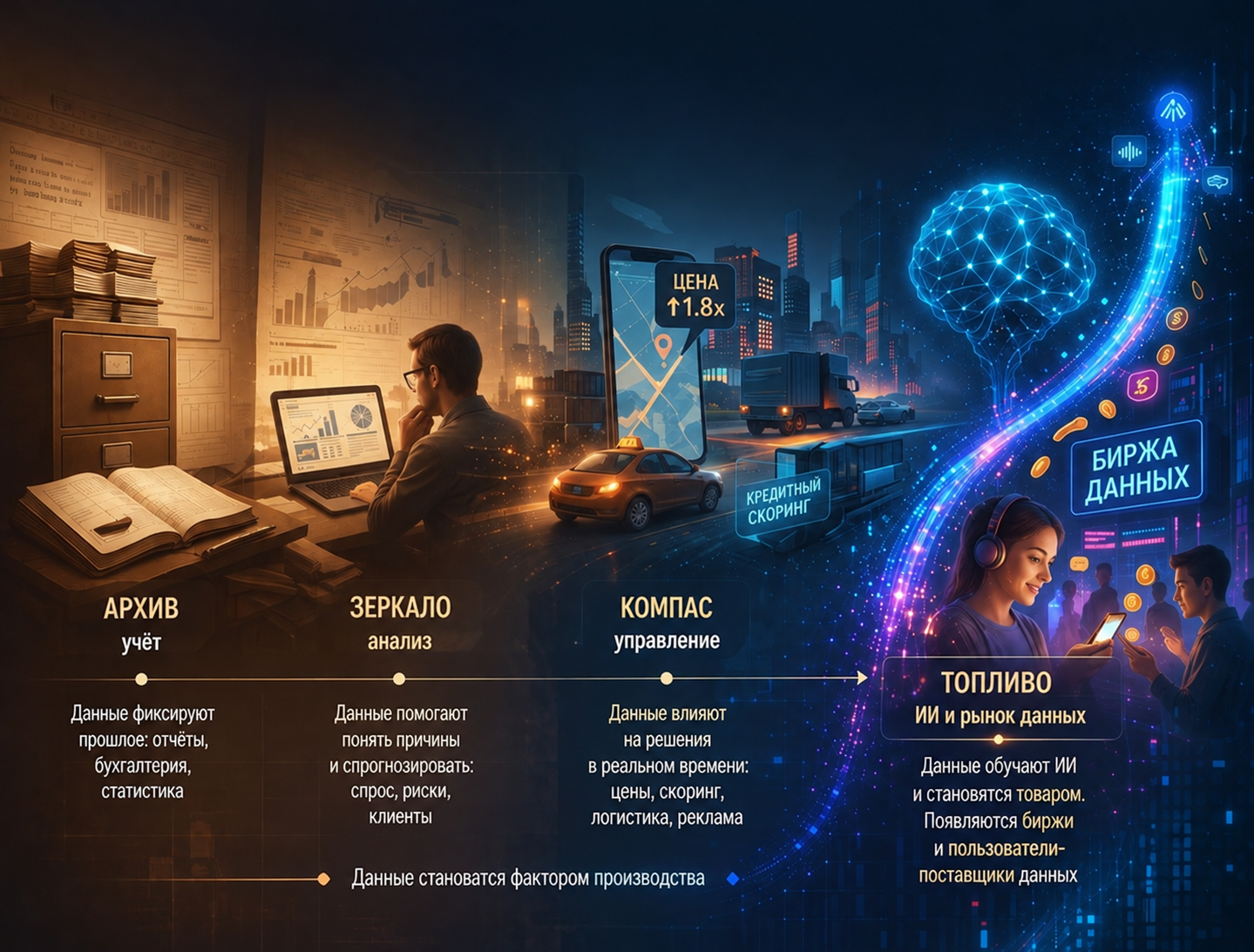
For a long time, land, labour and capital were considered the main factors of production. Later, knowledge, technology and entrepreneurship were added to the list. Put simply, a factor of production is anything essential to creating value.
Data entered this equation much later. Initially, it was more of a by-product of everyday activities: reports, records, transactions and statistics. Gradually, its role began to change. This transformation can be divided into several stages:
Archive
Data is primarily used to record what has already happened. Accounting records, reporting, statistical forms and transaction logs are typical examples.
Mirror
Data begins to be used for analysis. It helps organisations understand demand, risks, customer behaviour, the causes of failures and the efficiency of business processes.
Compass
Data no longer simply describes a situation. It begins to influence decision-making in real time. For example, prices on online platforms change depending on demand and user behaviour, while lending decisions increasingly rely on transaction histories and digital profiles.
Fuel
With the development of AI, data has become a critical resource. Models cannot be trained without it, and differences in data quality increasingly translate into differences in product quality, service performance and competitive positioning.
It is during these final two stages that data truly becomes part of the economy. It no longer simply helps organisations calculate or explain something, but becomes an integral part of how decisions are made and economic value is created. The development of AI has further accelerated this shift.
For many companies, data is becoming a source of competitive advantage just as important as capital, technology or market access.
The ways companies generate revenue from data are also changing. Previously, monetisation was mainly indirect:
- Governments used data to improve decision-making, policymaking and public administration.
- Companies used data to increase efficiency, build ecosystems and deliver targeted advertising. Today, direct data monetisation models are becoming increasingly common:
- Publishers, media companies and stock photography platforms are licensing their content for AI training.
- Data exchanges and marketplaces are emerging, where data are gradually becoming the subject of independent commercial transactions. However, the most significant shift may be taking place at the individual level. Personal data is gradually becoming part of this market as well. Platforms are emerging where users receive payments for their voice recordings, videos, conversations or even data about their everyday behaviour.
How exactly does personal data become a commodity, who profits from it, and where are the boundaries? We will explore these questions in the next post.